Becoming a Certified Play Area Safety Inspector: Frequently Asked Questions
1) Who is NPPAS certification for?
NPPAS is for professionals responsible for the safety and quality of children’s outdoor play spaces.
• Ideal for people working in childcare, schools, community programs,housing/residential operations, and parks/facilities.
• Useful for staff who inspect, educate, consult, maintain, or oversee safety and health of children’s outdoor spaces—including administrators and maintenance teams.
• Especially relevant if your role involves reducing risk, documenting issues, and improving outdoor environments for children.
2) What will I learn in the training?
You’ll learn how to inspect outdoor spaces for children, age appropriateness, quality learning experiences, identify hazards, and document findings through a research-based approach.
– Covers safety and developmental appropriateness across the entire outdoor environment -not just equipment.
– You’ll learn how to spot and prioritize risks, document them clearly, and communicate findings so improvements are actionable.
– Includes resources to support your inspection work.
3) Why is NPPAS considered the gold standard certification training?
NPPAS is recognized as the gold standard because it is performance based and requires inspectors to demonstrate real-world competence.
-Certification includes a comprehensive onsite inspection, a detailed inspection report, and the application of research, guidelines, and local regulations in actual environments.
-The curriculum covers the full spectrum of child-centered outdoor safety, from environmental hazards to climate resiliency and equipment safety.
-The training resources you receive are the most reliable and comprehensive tools available—built on research, field testing, and real incident data—making them the strongest foundation for inspection practice.
4) How long is the training?
NPPAS training is delivered across multiple live online sessions, offered in scheduled cohorts throughout the year.
-Sessions are instructor led, interactive, and spaced across several dates to support learning and application.
-Multiple cohorts are available so you can select a timeframe that fits your schedule.
-Registration deadlines apply, so planning ahead helps ensure you get your preferred dates.
5) How does the live online training work?
The training is fully live and interactive—built around discussion, real examples, and practical application.
-Instructor led sessions include case studies, pictorial examples, and guided walkthroughs.
-You can ask questions in real time and learn from others’ questions as well.
-The format is designed to help you understand both why it matters and what to do in the field.
6) How do I get NPPAS certified?
You earn NPPAS certification by completing the live training sessions, finishing the self-paced learning activities, and conducting an onsite inspection.
-During training, you’ll learn the standards, best practices, and inspection approach; complete hands-on learning activities that build contextual understanding; and practice thinking through real world scenarios rather than memorizing numbers.
-Certification is awarded once you demonstrate you can apply what you learned by passing a comprehensive onsite hands-on safety inspection.
7) What does the onsite inspection involve?
The onsite inspection requires you to visit an outdoor space for children, examine age appropriate learning experiences, identify hazards and risks, and create a clear inspection report with your findings.
-You will assess the entire space—not just equipment—using a child-focused lens.
-The process emphasizes identifying foreseeable hazards, noting opportunities to strengthen outdoor learning, and documenting your findings so owners and operators can act on your recommendations.
-You’ll use NPPAS provided resources, such as checklists and guidance tools, to support accuracy and consistency.
8) Which course should I take: Early Childhood or School-Age?
Choose Early Childhood if you work in infant, toddler, or preschool environments. Choose School Age if you inspect outdoor spaces at elementary or middle schools, community parks, public facilities, public housing areas, or municipalities.
-The Early Childhood course focuses on childcare outdoor learning spaces and their unique expectations.
-The SchoolAge course focuses on outdoor environments for children ages 5–12, including schools, public recreation areas, community/neighborhood parks, public housing units, and municipal spaces.
9) Is NPPAS recognized by licensing or other agencies?
Yes. NPPAS is widely aligned with the needs of child-focused programs and regulatory agencies because it evaluates the entire outdoor environment through a child-centered lens.
-The training is designed for professionals working in childcare settings, state licensing offices, CDC programs, Head Start, and other early learning systems.
-It is relevant for Risk Managers, Health and Safety Administrators, Maintenance Teams, and Program Leaders serving school-aged children.
-Because NPPAS addresses broader health and safety considerations—not just equipment—it fits well within many agency expectations.
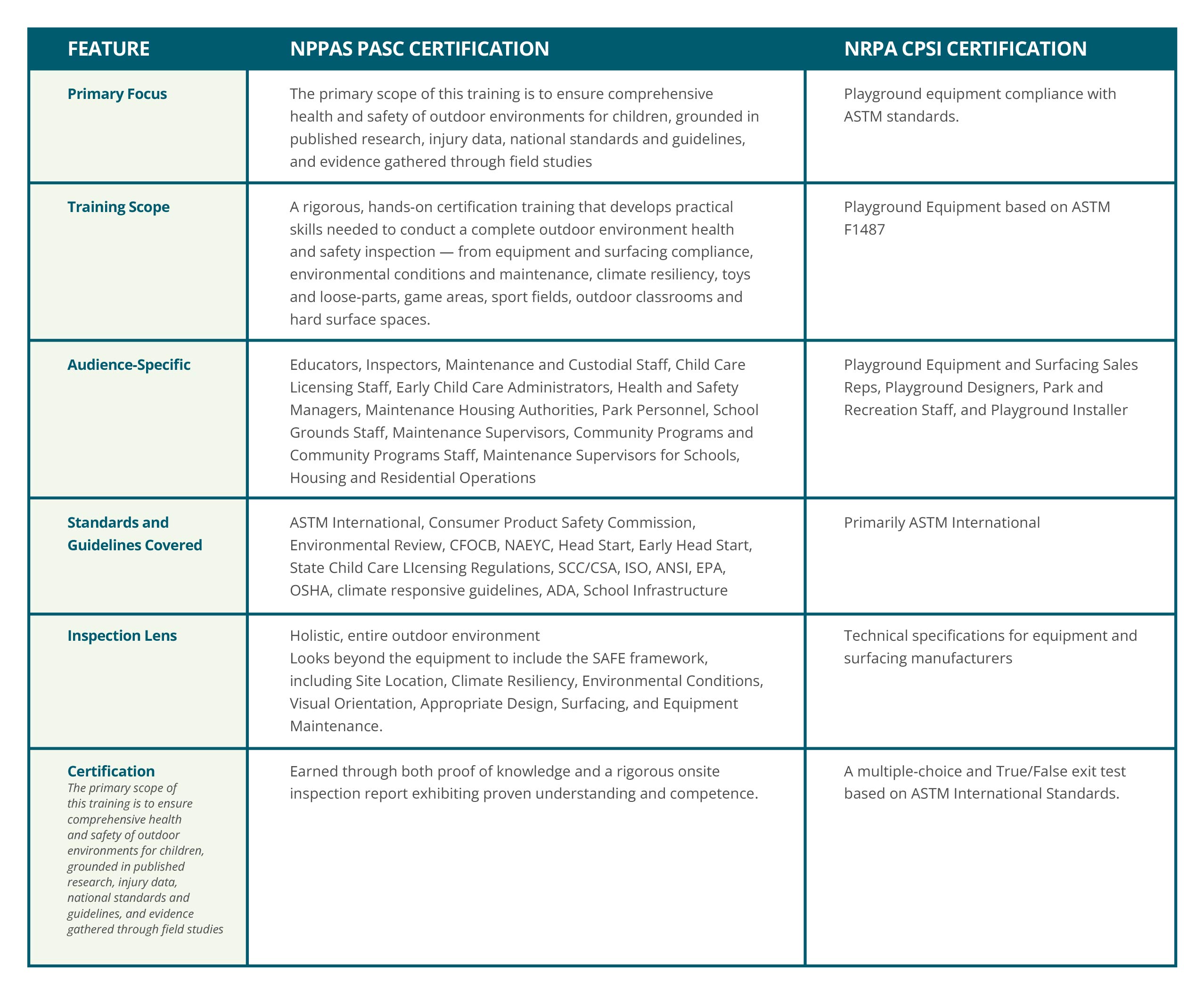
10) How is NPPAS different from NRPA/CPSI?
NPPAS is whole‑environment and child‑focused, while CPSI is primarily centered on playground equipment compliance.
-NPPAS evaluates the entire outdoor play space, including environmental hazards and learning areas.
-CPSI is commonly associated with equipment compliance and manufacturing‑focused standards.
-If your responsibilities include childcare or school environments, a whole‑space inspection lens is a better fit.
11) What standards and guidelines does the training cover?
The training draws from research literature, health and safety regulations, environmental health topics, and multiple standards and guidance sources relevant to outdoor and child-focused environments.
-It includes standards and guidance that go beyond traditional manufacturing requirements and supports practical application across loose parts, playground equipment, toys, surfacing, accessibility, and program expectations.
-The training engages with research studies and teaches you how to interpret and apply guidance in real settings—not simply memorize numbers and references.
12) When do I need to recertify?
Recertification occurs every three years.
-This maintains professional accountability, supports continued competency, and ensures inspectors stay current with research, evolving standards and best practices.
-NPPAS offers scheduled recertification windows throughout the year to make planning easier.
13) What do I need to do to recertify—do I retake the course?
No. Recertification does not require repeating the training. It focuses on demonstrating continued competency.
-The process is designed to confirm that you can still apply inspection expectations confidently and accurately.
-This keeps recertification centered on real ability rather than re‑taking an exam or coursework.
-You can plan around the published recertification windows and deadlines.
14) How do I register or sign up a group?
You can register online, and groups can email PlaySafe@NPPAS.org for coordinated enrollment.
– Individual registration is straightforward through the registration page.
– If you’re registering a team, reaching out early can help with planning and deadlines.
Early Childhood Play Areas Safety Inspector
Develop the expertise to evaluate and inspect safe, climate resilient, healthy, and developmentally appropriate play environments for infants, toddlers, and preschoolers.
School-Age Play Areas Safety Inspector
Build the expertise to inspect safe, climate resilient, accessible, and developmentally appropriate play areas in public spaces for children ages 5-12.
Play Area and Playground Safety Inspector Recertification
Keep your skills and credentials current with a playground safety certification renewal, demonstrating your knowledge and understanding.
NPPAS Comparison Chart